
Blog

How to Pick the Best Web Design Company for Your Business

Searching for the best web design companies can give you a long list of businesses that all promise attractive websites and professional service.

But how do you know which one is right for you?

The best choice for one business may not be the best choice for another. Your budget, website requirements and plans for maintaining the site all matter.

Instead of choosing a company based on a ranking or advertisement, start by looking at what the company actually offers and how it works with customers.
Nuts and Bolts Web Design

1. Look at Real Website Projects

A web design company’s portfolio is a good place to start.

Look for completed work that shows different layouts, industries and types of websites.

As you review the examples, ask yourself:

  • Is the website easy to navigate?
  • Can I find the information I need?
  • Does the design fit the type of business?
  • Does it appear usable on a mobile device?
  • Can I see work that relates to my own needs?

You do not need to find a company that has designed a website for your exact industry.

You do want evidence that it can handle different requirements and create a design appropriate for your business.

Take a look at NABWD’s Web and Logo Design Portfolio for examples of our work.

2. Find Out What the Price Includes

Two web design quotes can look similar until you read the details.

One company may include custom layouts, content placement and contact forms. Another may charge separately for those items.

Ask each company to explain what is included before comparing prices.

Important questions include:

  • How many design options will I receive?
  • How many website pages are included?
  • Will the company add my existing content and images?
  • Are contact forms included?
  • Will I be able to update the website myself?
  • Is training provided?
  • Are hosting and maintenance separate charges?
  • What happens if I need additional features?

A clear scope can help prevent disagreements later.

3. Understand the Difference Between a Website and a CMS

Not every website needs the same technology.

Some businesses need a relatively straightforward website that presents their services and contact information.

Others need to update pages regularly, manage content themselves or use custom features.

A content management system (CMS) gives authorized users a way to manage website content without editing the underlying code for every change.

Ask whether the quoted price includes a CMS and what you will be able to manage after launch.

At Nuts and Bolts Web Design (NABWD), a standard website build is $1,400. Custom-built CMS websites start at $1,800.

We also develop websites using WordPress, Shopify and custom code. The appropriate approach depends on your project.

Our Web Development page explains these options.

4. Ask About Support After Launch

Your website will eventually need updates.

You may introduce new services, change contact information or need help with something that stops working.

Before hiring a web design company, ask what happens after the website is launched.

Does the company offer ongoing maintenance? Can you request individual updates? Who should you contact when something needs attention?

Also ask about hosting.

Website development, hosting and maintenance may be bundled together or sold separately. Neither approach is automatically better, but the arrangement should be clear.

You should understand what you are purchasing and what future services may cost.

5. Read Customer Feedback

Testimonials can provide another perspective on working with a web design company.

Look for comments about communication, responsiveness, the development process and support.

A positive review alone does not guarantee your project will go the same way. However, feedback can help you decide what questions to ask.

You can read feedback from NABWD clients on our Testimonials page.

6. Watch for Warning Signs

Be cautious when a company cannot clearly explain its services.

Some warning signs include:

  • No portfolio or relevant work examples
  • Unclear pricing or project requirements
  • No explanation of what happens after launch
  • Pressure to sign before you understand the agreement
  • Promises of guaranteed search rankings or business results
  • No clear way to contact the company when you need help

Not every small web design company has a large portfolio or a complicated process. That is not necessarily a problem.

What matters is whether the company can explain its work, answer your questions and give you a clear understanding of the project.

7. Compare Quotes Fairly

When you receive two or three quotes, do not compare the final prices alone.

Put the included services next to each other.

Look at the number of pages, design options, forms, content management features, training and support.

Also consider what is not included.

One quote may be lower because it covers a smaller project. Another may be higher because it includes features you do not actually need.

A useful quote should help you understand what you are paying for.

If a proposal includes something you do not understand, ask the company to explain it before making a decision.

How Working With NABWD Works

NABWD is based in Newark, Delaware. We work with businesses and nonprofits locally and with clients in other locations.

Our website development process is straightforward.

First, you request a quote. Tell us what your business does, what you need from your website and what budget you have in mind.

Next, we prepare two custom website layout options. You review the designs and provide feedback.

Then, we build the website. Development follows the agreed design direction and project requirements.

You review the finished work. We address items identified during the review and prepare for launch.

Finally, the website launches. Optional hosting and maintenance services are available separately if you need continued assistance.

We publish our starting prices because it helps both sides discuss a realistic scope from the beginning.

So, Which Web Design Company Is Best?

The best web design company for your business is one that understands your needs, communicates clearly and provides work that fits your budget.

Look beyond the headline price or a search result ranking.

Review actual work. Ask questions. Compare what is included and make sure you understand who will support your website after launch.

Taking the time to make an informed decision can help you choose a company you are comfortable working with.

Ready to discuss your project? Request a Web Design Quote.

Featured image: Photo by Sora Shimazaki on Pexels.

The Benefits of Hiring a Design Agency

Running a small business means wearing several hats. You may be handling customer questions, managing employees, keeping up with paperwork and trying to find time to improve your website.

Your website is important, but building and maintaining it can become another job on an already busy schedule.

Hiring a professional design agency gives you someone who can handle the technical work while you focus on your business.

Nuts and Bolts Web Design

What Does a Design Agency Actually Do?

A design agency does more than make a website look nice.

A professional web design project involves understanding your business, planning the layout, organizing your content and building a website that visitors can use.

Depending on your needs, that work may include:

  • Custom website design and development
  • Mobile-friendly layouts
  • Contact forms and other website features
  • Content and image placement
  • Website hosting
  • Maintenance and technical support

The goal is to build something that works for your business instead of simply filling a template with text and pictures.

1. Save Time and Stay Focused on Your Business

There are plenty of tools that let you build a website yourself. That can be a reasonable option for some businesses.

The question is how much time you want to spend learning the tools, fixing problems and keeping everything updated.

You might also have an employee who knows a little about websites. That person may be able to help, but website maintenance can quickly become another responsibility competing with their regular work.

Working with a design agency allows you to explain what you need and have someone manage the development process.

You still make the important decisions. You just don’t have to handle every technical detail yourself.

2. Give Your Business a Consistent Appearance

Your website should look like it belongs to your business.

Your logo, colors, images, navigation and written content should work together. Visitors should not feel as though they have landed on several different websites while moving between pages.

A design agency can help you establish a consistent appearance that carries across your website and other business materials.

Consistency also makes future updates easier because there is an established design to follow.

3. Make a Good First Impression

For many potential customers, your website is their first introduction to your business.

They may want to see what you offer, where you are located, examples of your work or how to contact you.

A confusing website can make those answers difficult to find. A clear, professional presentation helps visitors evaluate your business before deciding whether to call or send a message.

Good design cannot guarantee that someone becomes a customer, but it can make the experience of learning about your business easier.

4. Keep Design, Hosting and Support Connected

One challenge with managing a website yourself is figuring out who to contact when something stops working.

The domain may be registered with one company. Hosting may be with another. The website might have been built by someone who is no longer available.

Having an ongoing relationship with a web design business can make those conversations easier.

At Nuts and Bolts Web Design (NABWD), website development, Linux web hosting and website maintenance are available as separate services. You can choose what your business needs instead of being required to purchase everything together.

Visit our Services page to see the available options.

5. Get Help After Your Website Launches

A website is not something you should forget about once it goes live.

Businesses change. Contact information needs updating. New services are introduced. Software and website features may also need attention.

Planning for future updates helps keep your website useful.

NABWD offers optional hosting and maintenance services for customers who want continued assistance after their website launches.

How NABWD Handles a Website Project

We keep the process straightforward.

Request a Quote: Tell us about your business, your budget and what you need from your website.

Review Your Design Options: We prepare two custom website layout options for your review.

Website Development: Once the design direction is selected, we build the website around the agreed project requirements.

Client Review: You review the website before launch so we can address items identified during the review.

Launch: After the final review, the website goes live.

Our standard website build is $1,400. Custom-built CMS websites start at $1,800 for clients who need their own content management system.

You can read more about these options on our Web Development page.

Is Hiring a Design Agency Worth It?

That depends on what your business needs.

If you have the time and technical knowledge to build and maintain your own website, doing it yourself may work well.

If you would rather spend that time operating your business, working with a professional design agency can be a practical investment.

The biggest benefit is having someone who understands the work and can help you move from an idea to a finished website.

Ready to discuss your website? Request a Web Design Quote.

Featured image: Photo by Tony Schnagl on Pexels.

What’s an A record?

A records (also known as host records or address records) point a domain name or subdomain to an IP address. For example, if you want your domain “yourOwnDomainName.com” to point to your home computer (whose IP address is, for example, 192.168.0.1), the A record would list “yourOwnDomainName.com”, or “@” as the host and “192.168.0.1” as the “pointing” IP address. Entering “@” for the host name is the same as entering your domain name, minus the “www”. Entering “www” for the host name is the same as entering your domain name, including the “www”.

To create a wildcard A record, enter an asterisk (“*”) for the host name. The wildcard makes the server respond with the IP address specified instead of an error, if the subdomain queried does not exist within your zone file.

What’s a CNAME record?

CNAME records (also known as alias records) point a subdomain to an existing A (host) record so that the domain points to the appropriate IP address.

Entering “@” for the host name is the same as entering your domain name, including the “www”.

The Points To Host Name should be defined as your domain name (i.e., “yourOwnDomainName.com”) or “@” (Entering “@” will automatically insert your domain name as the host name for the CNAME Record). The Alias field should be the subdomain of your top-level domain the CNAME record points to your domain.

For example: If you want the CNAME record to point “www” within your domain to “www.yourOwnDomainName,” you should enter “www” in the Alias field and “yourOwnDomainName.com” in the Points To field. If you want the CNAME record to point “email” within your domain to “email.yourOwnDomainName,” enter “email” as the Alias and “email.yourOwnDomainName.com” as the Points To Host Name.

The Education Behind Nuts and Bolts Web Design

I run Nuts and Bolts Web Design. Every so often, a client asks what qualifies me to build and look after their website. It is a fair question, so here is the paper trail.

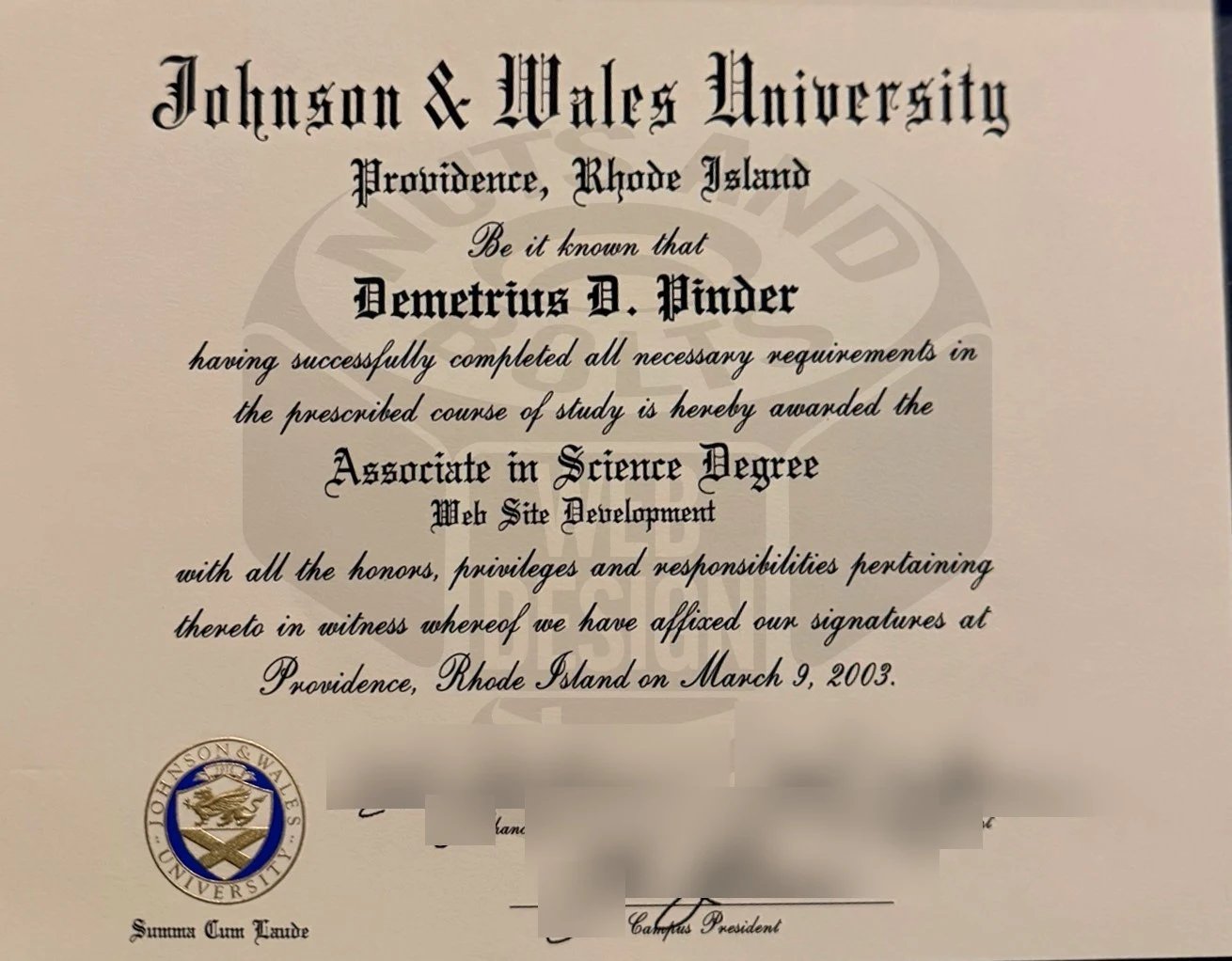
I earned my Associate in Science in Web Site Development from Johnson & Wales University in Providence, Rhode Island, on March 9, 2003. I graduated Summa Cum Laude.

Diploma for an Associate in Science in Web Site Development from Johnson & Wales University, awarded to Demetrius D. Pinder in 2003, Summa Cum Laude. Signatures blurred.
Associate in Science in Web Site Development, Johnson & Wales University, March 9, 2003. Summa Cum Laude.

(signatures blurred for respect of privacy)

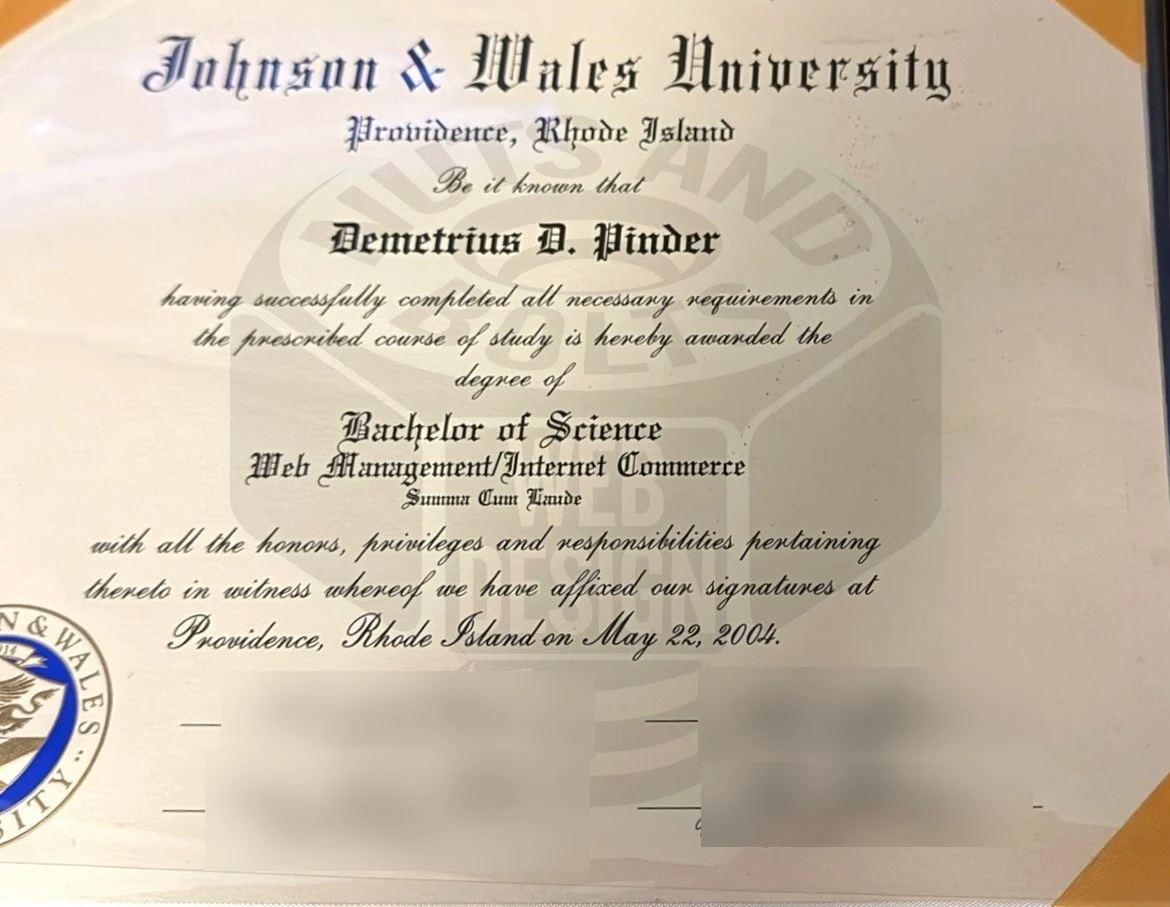
A year later, on May 22, 2004, I earned my Bachelor of Science in Web Management/Internet Commerce from Johnson & Wales, again Summa Cum Laude. NABWD started that same year. The degree covered building websites and running business on the internet, and I have been doing both ever since.

Diploma for a Bachelor of Science in Web Management/Internet Commerce from Johnson & Wales University, awarded to Demetrius D. Pinder in 2004, Summa Cum Laude. Signatures blurred.
Bachelor of Science in Web Management/Internet Commerce, Johnson & Wales University, May 22, 2004. Summa Cum Laude.

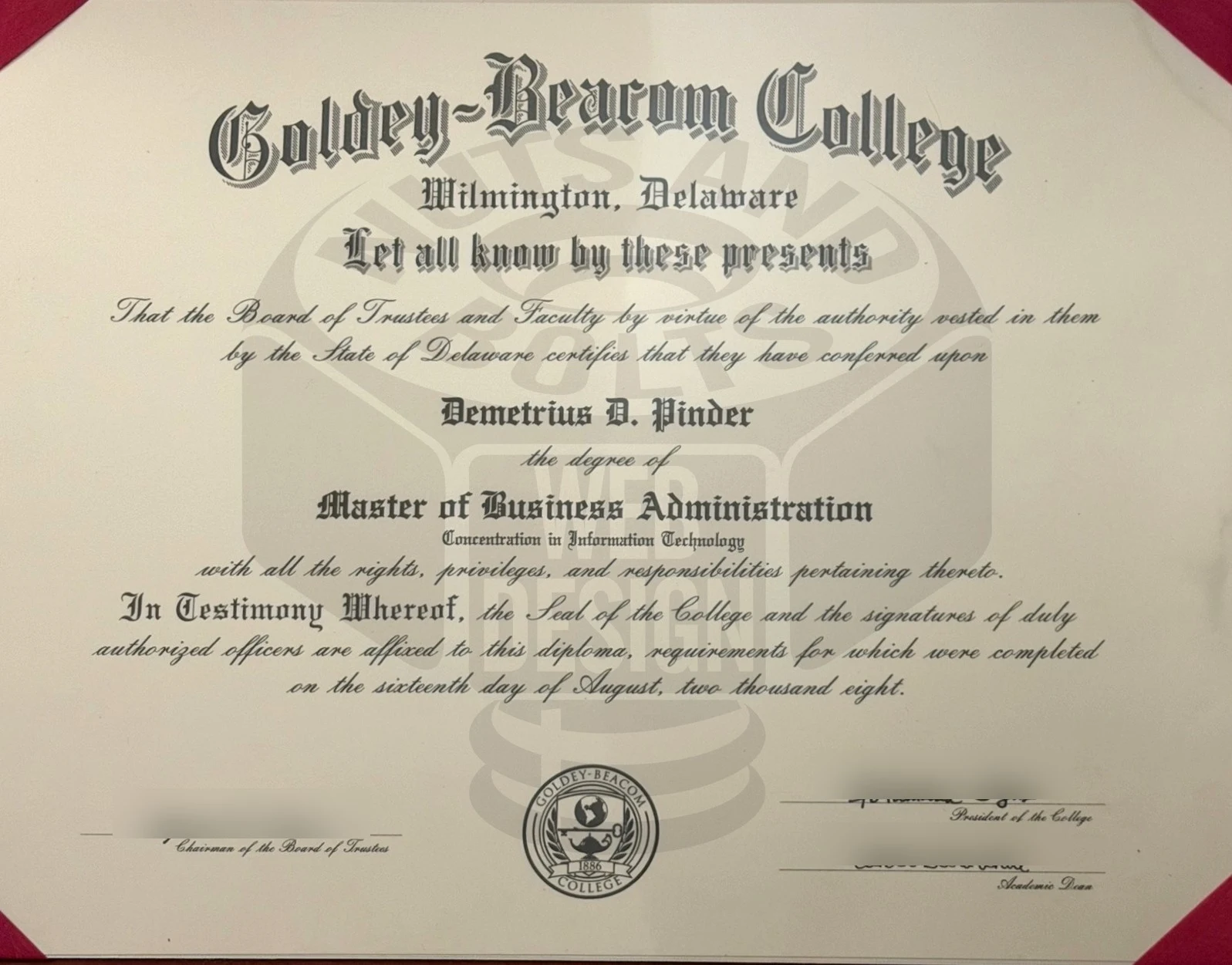
On August 16, 2008, I earned my MBA with a concentration in Information Technology from Goldey-Beacom College in Wilmington, Delaware. The business side matters in this work. Most of my clients are small businesses and nonprofits, and it helps to understand their side of the desk.

Diploma for a Master of Business Administration with a concentration in Information Technology from Goldey-Beacom College, awarded to Demetrius D. Pinder in 2008. Signatures blurred.
MBA with a concentration in Information Technology, Goldey-Beacom College, August 16, 2008.

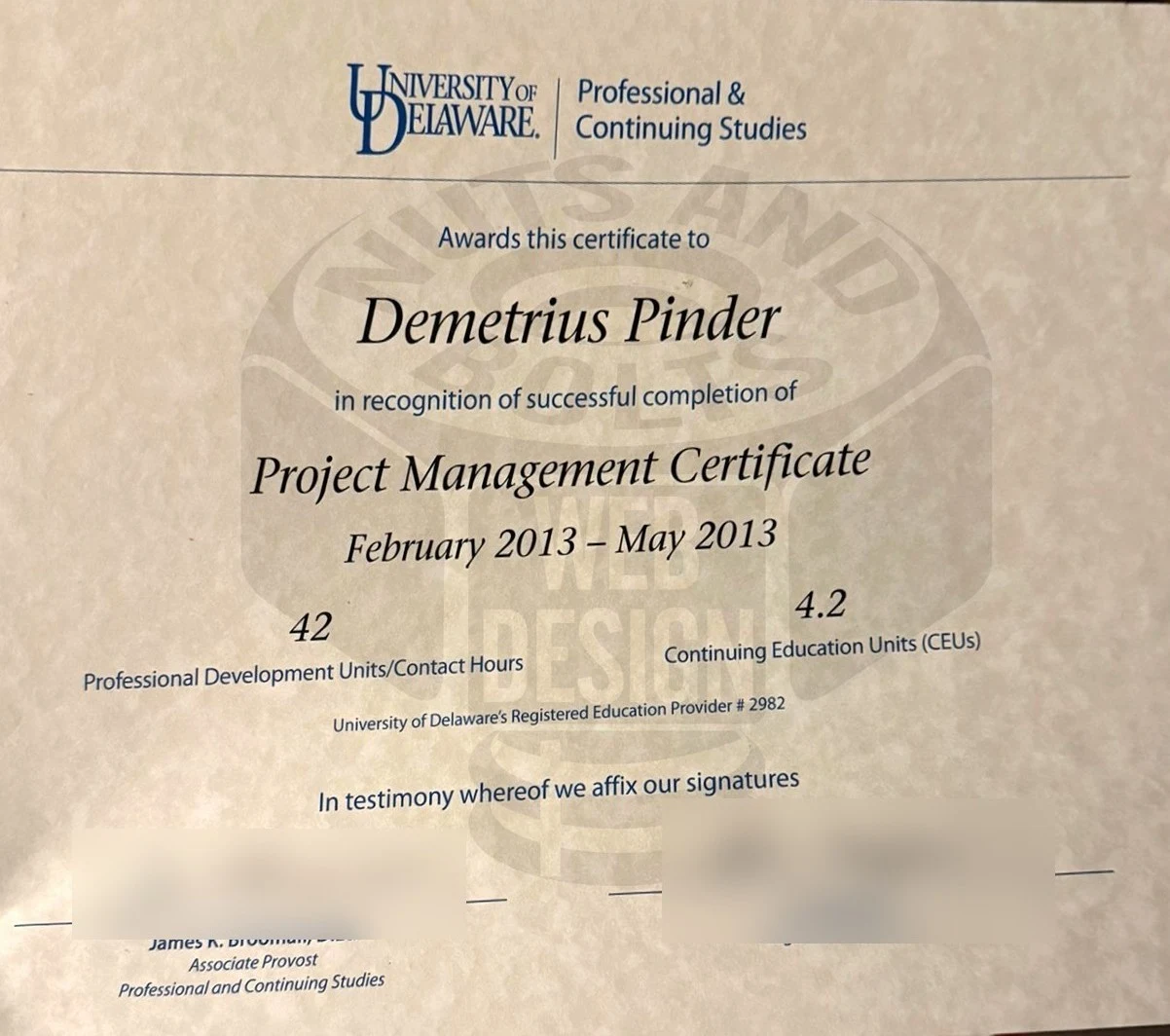
In May 2013, I completed the Project Management Certificate at the University of Delaware. The program ran from February to May and carried 42 professional development units. Website projects live or die on scope, schedule and follow-through. That training sharpened all three.

Project Management Certificate from the University of Delaware, awarded to Demetrius Pinder in 2013. Signatures blurred.
Project Management Certificate, University of Delaware, May 2013.

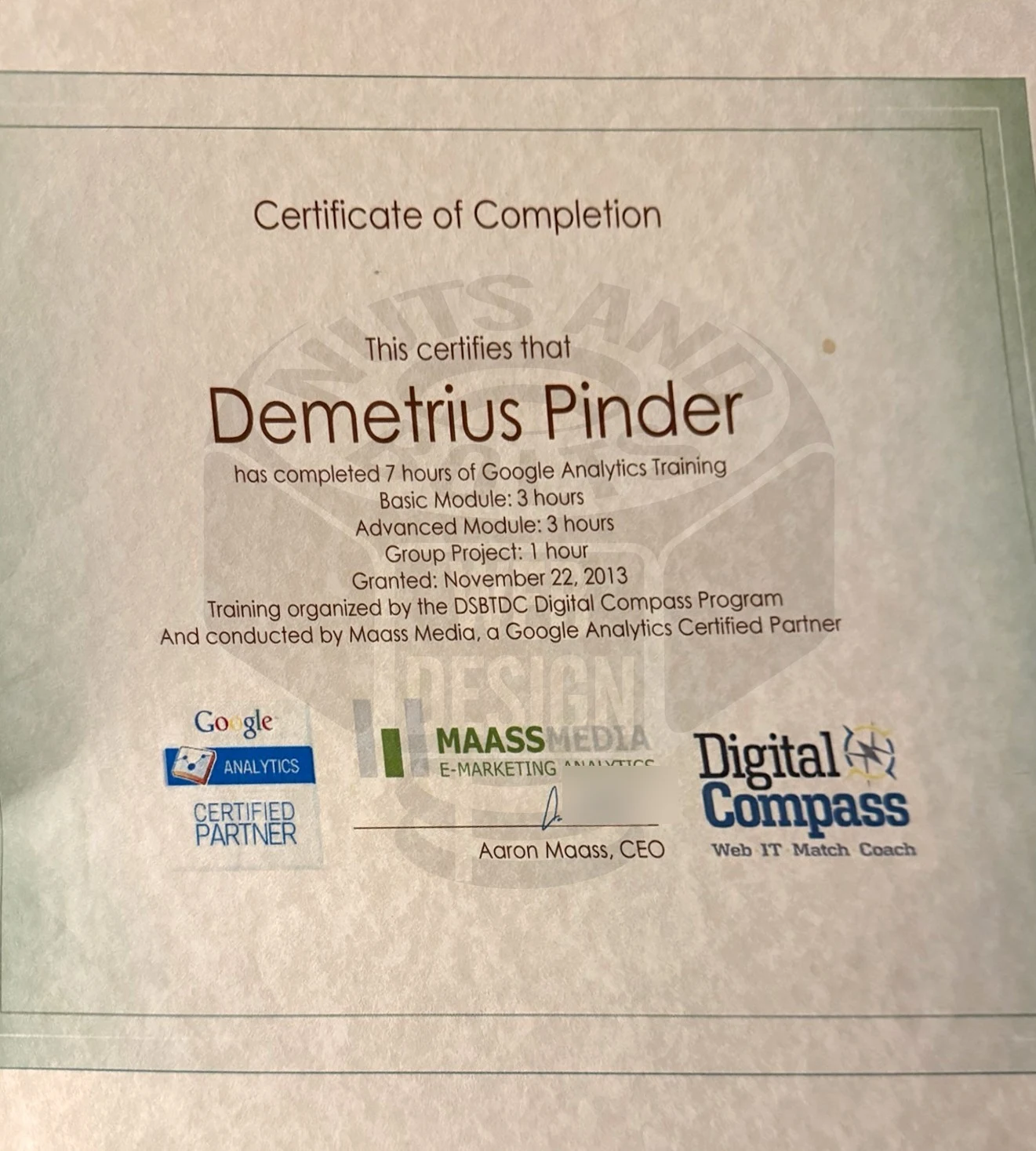
In November 2013, I completed 7 hours of Google Analytics training through the DSBTDC Digital Compass Program, conducted by Maass Media. Clients want to know whether their website is working, and measurement is how you answer honestly.

Certificate of Completion for 7 hours of Google Analytics Training, awarded to Demetrius Pinder in 2013. Signature blurred.
Google Analytics Training certificate, DSBTDC Digital Compass Program, November 22, 2013.

School gave me the foundation. The work itself taught me the rest, one client and one project at a time. These days the projects also include building games with my daughter as Cul-de-Sac Crew, but websites for businesses and nonprofits are still the heart of what I do.

My experience and skills are shown in every project I touch.